Audi Q9 Digital Matrix Lights Add Road-Projected Turn Signals
The 2027 Audi Q9 brings matrix headlights to U.S. buyers, with road-projected turn arrows available in higher-priced packages.
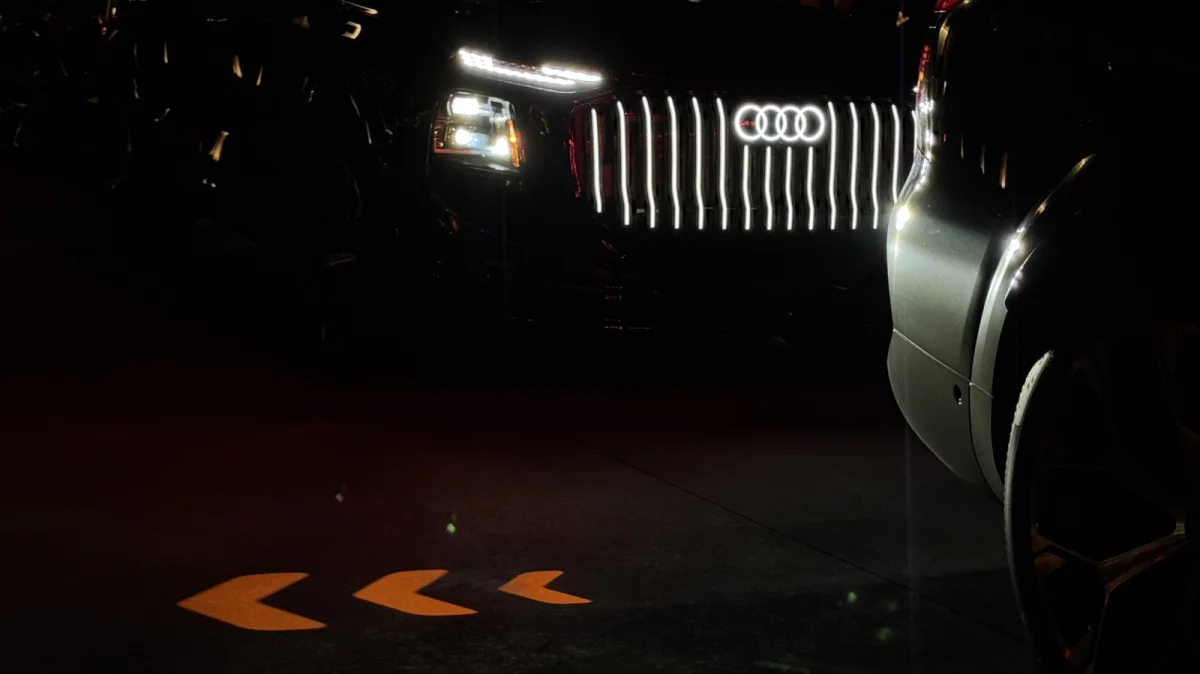
Audi’s digital matrix headlights bring a useful twist to the 2027 Q9: they can keep high beams on while masking other vehicles and road signs, and project turn arrows onto the pavement. The Q9 is the first U.S.-spec Audi fitted with the system, which the company has offered elsewhere for years. For drivers, the distinction matters: the headlights aim to improve visibility on dark roads, while the projected signals could make a car’s intentions easier to spot when it’s pulling away from a curb.
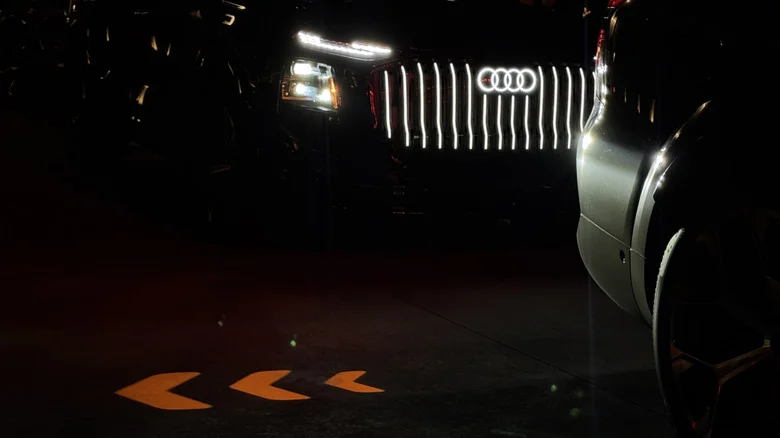
Audi has built a reputation around lighting features, from its early use of LED daytime running lights to the customizable running-light designs offered on several recently updated models. The Q9 continues that push. Its new lighting hardware includes digital matrix LED headlights, road projections, and curved OLED taillights. The latter are described as the first curved OLED taillights fitted to a road car.
The Q9 is also the first Audi model for U.S. buyers to pair the matrix technology with a setup designed to meet current U.S. headlight requirements. The system’s central idea is straightforward: preserve the extra reach of high beams while shaping the light around other road users. Making that work as traffic and signs move through the beam takes more than simply dimming the headlights.
High beams with a moving dark zone
A camera mounted behind the rear-view mirror scans the road ahead for vehicles and road signs. With high beams active, the headlights create small unlit areas around those objects, leaving the rest of the road illuminated. As cars move, the darker zones follow them. The driver gets a broad field of high-beam light, while the beam avoids shining directly at the detected traffic or signs.
That was the setup Audi demonstrated to journalists on dark roads in Utah. The test drive showed the practical appeal most clearly away from street lighting: the Q9’s high beams illuminated a wide stretch of road, and the masked areas around other cars and signs were hard to pick out. That observation comes from a demonstration drive, so conditions on other roads may differ. Still, the feature addresses a familiar tradeoff for night driving: using high beams for better forward visibility while sharing the road with oncoming and leading traffic.
 Audi
The system’s ability to shape its beam is the key distinction from a conventional high-beam setup. Rather than asking the driver to switch between high and low beams as traffic approaches, it adjusts where the light falls. Audi’s demonstration suggests the masked areas don’t substantially disrupt the driver’s view, though the report offers no measured comparison of visibility or beam performance.
Signals projected beyond the body
Small projectors in the headlights and taillights can cast turn arrows onto the road when the headlights are on. The arrows weren’t especially bright or easy to see in every condition during the demonstration, but their position could help in a specific situation: a Q9 parallel parked on a busy street. As the driver signals to pull out, approaching traffic may see an arrow on the pavement before the car’s built-in signal lamps are clearly visible.
That use case is plausible because the projection extends beyond the vehicle’s body, putting the signal where other drivers may notice it sooner. Its value will depend on visibility in real traffic, lighting conditions, and the angle from which another driver approaches. The demonstration establishes that the feature works; it doesn’t settle how often the projected arrows will be visible enough to change another driver’s response.
On Q9 models with the Prestige package, white rhombus-shaped projections appear beneath the front and rear doors. They unfold when a door opens and can also warn that a passenger may be exiting when a cyclist or car approaches. The Q9 combines these projections with an exit-warning system that uses radar sensors in the rear bumper to detect approaching vehicles, cyclists, or pedestrians. The system can prevent a door from opening or stop one that’s already moving into an obstacle’s path; the projections add a visual warning around the vehicle.
The curved OLED taillights add another display function: when the hazard lights are activated, they can show a hazard triangle. Drivers can also choose from eight daytime-running-light signatures, extending the customization available on other recent Audi models to the Q9.
Equipment and package costs
Digital matrix lights are standard on the Q9 Premium Plus and higher trims, and on the SQ9. The advanced turn-signal projections require an additional package on the Premium Plus: they’re included in the $14,700 Prestige package for the Q9. On the SQ9, they come with the $4,750 Luxury package, which also includes powered doors.
That pricing makes the projected arrows a package-dependent extra rather than a feature every Q9 buyer gets with the matrix headlights. The distinction is worth checking when comparing trims: the basic matrix lighting and the more visible road signals aren’t bundled together across the range.
These systems add cameras, sensors, projectors, and specialized lighting hardware, so repairs could be more involved than replacing a conventional lamp if components are damaged. The source provides no replacement prices, and costs will depend on the fault. For now, the Q9’s clearest lighting advantage is its ability to keep much of the road lit without directing the high beam at detected traffic. The projected turn arrows are a more conditional benefit, with their usefulness depending on whether other drivers can see them in time.
Audi has spent years developing lighting as a visible part of its vehicle technology. With the Q9, the matrix headlights reach U.S. buyers alongside exterior projections that extend beyond illumination. How much the arrows help in everyday driving remains to be seen, but the beam shaping already has a clear purpose on dark, unlit roads.