Europe’s Battery Cell Capacity Could Meet EV Demand by 2030, T&E Finds
T&E says planned European cell output could cover eligible EV demand by 2030, but cathode materials remain the weak link.
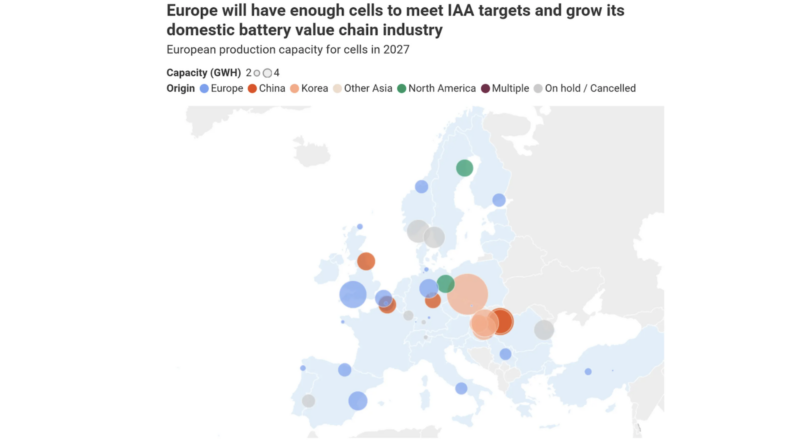
Europe may have enough planned battery cell production to supply electric cars covered by the proposed Industrial Accelerator Act (IAA) by 2030. The tougher question is whether local producers of cathode materials and their precursors can secure the steady orders needed to scale alongside cell factories.
That is the central finding of new analysis from Transport & Environment (T&E), which says planned European cell capacity could meet demand for eligible battery electric vehicles, provided all projects in its assessment proceed, including those rated medium confidence. The scope includes company cars and privately purchased EVs that receive public support. The finding challenges claims from the car industry that local content criteria would exceed available capacity.
The forecast depends on more than factory announcements. T&E’s assumptions cover light-duty EVs, including vans, and include projects producing both lithium iron phosphate (LFP) and nickel manganese cobalt (NMC) cells. The analysis also assumes the current balance between private and company car sales continues, counts EVs already using European cells, and includes a shift to local cells for eligible cars assembled in Europe. T&E describes its production ramp-up assumptions as voluntarily pessimistic.
Under the current proposal, battery components for company cars would need to be made in the EU. Privately purchased cars receiving subsidies could use components from EU trade agreement partners. T&E argues that requirements covering cells and cathode active materials could raise demand for EU batteries by 34% over the current baseline in 2027.


Cell output is only part of the supply chain
Cell factories assemble materials produced further upstream. Cathode active materials (CAM) and their precursors (pCAM) are two key inputs, and T&E identifies them as the most exposed part of Europe’s battery supply chain. China accounts for up to 90% of global production capacity for these materials, depending on the battery chemistry; for LFP, its share reaches 95%.
That concentration matters because local cell production alone does not create a fully local battery supply chain. European CAM and pCAM plants need dependable orders from cell manufacturers to justify investment. Cell makers, in turn, need a predictable EV market and long-term supply plans. If either side hesitates, capacity plans can stall even when the other part of the chain is ready.

T&E’s map tracks cell and pCAM/CAM production capacity across Europe and illustrates the potential to expand domestic supply. The analysis says CAM requirements for company vehicles under the IAA are feasible, while additional capacity would be needed to cover demand from privately purchased vehicles. It also calls for a minimum EU-made pCAM threshold that could be met with trusted partners, describing this segment as particularly vulnerable.
The proposed demand rules are intended to give suppliers a clearer reason to invest. For battery makers and automakers, the practical effect would be a stronger link between eligible vehicle sales and local component sourcing. The scale of that effect would depend on how the requirements are written, which vehicles qualify, and whether planned production projects reach volume. T&E’s conclusion is therefore conditional: sufficient cells are possible if projects materialize, while upstream materials need further capacity and firmer demand commitments.
Rules will shape investment certainty
Xavier Sol, T&E’s director of sustainable investments and batteries, said the stakes include high-value clean technology jobs and the resilience of Europe’s automotive sector. He argued that a strong local battery chain could support those goals, but that investors need a clear signal through the IAA to reduce the risk of committing capital.
The broader industry context is competition from imported batteries, including Chinese products that T&E says face virtually no tariffs. The organization argues that demand-side requirements could help European suppliers compete by creating a dependable market for locally produced components. For automakers, the sourcing rules could also affect how they plan supply for company fleets and subsidized private EVs.
A first test of the region’s “Made in Europe” approach is due in January, when local content rules for EVs under the EU-UK Trade and Cooperation Agreement are scheduled to take effect. The source reports that carmakers are seeking a delay. T&E says the credibility of future local content rules will depend on whether this timetable holds.
For buyers, the analysis does not provide a forecast of vehicle prices, battery costs, or model availability. Its focus is industrial capacity: Europe could produce enough cells for the EVs within the IAA’s scope by 2030, but that outcome rests on projects being completed and on investment extending into cathode materials and precursors. The next signal to watch is whether proposed sourcing rules give those upstream suppliers the durable orders they need to build.