China Tightens Standards for Reusing Retired EV Batteries
China’s new rules shift second-life batteries toward application-specific testing as cheaper new packs sharpen the economics of reuse.
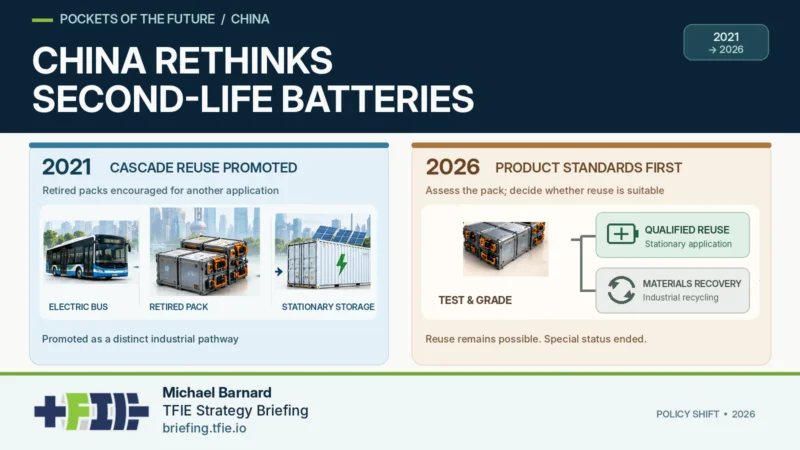
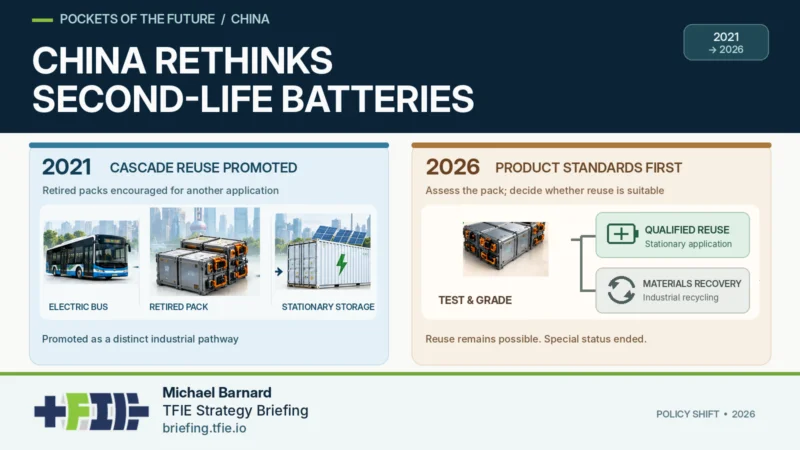
China’s change in approach to retired EV batteries reflects a practical question for the next phase of electrification: when does a used pack make sense as a storage product, and when is recovering its materials the better option? New rules that took effect in April 2026 replace a framework that encouraged “cascade utilization” with a stronger focus on testing and standards for each use. They don’t amount to a blanket ban on second-life batteries, but they raise the bar for products made from them.
A large fleet is reaching the next stage
China is confronting this question at unusual scale. After years of electrifying urban bus fleets, the country had 551,400 new-energy urban buses by the end of 2025, equal to 87.5% of its urban bus fleet. Those vehicles have spent years in service, so battery retirement is increasingly an industrial issue rather than a handful of demonstration projects.
That experience gives China a view of what happens after the first owner’s use is over. Batteries that no longer suit demanding vehicle duty may still hold useful capacity. But packs returning from vehicles vary in age, design, condition and operating history. A market built around that supply has to establish which packs can be reused, where they belong and how their performance can be verified.
From broad encouragement to product standards
In 2021, Chinese rules encouraged businesses to put retired EV batteries to work in stationary storage, backup power and charging infrastructure. The appeal was straightforward: a pack with reduced capacity might still store electricity, potentially delaying the need to manufacture another battery for a less demanding job.
Rules effective in April 2026 repealed that earlier cascade-utilization framework. On July 30, the Ministry of Industry and Information Technology said it was withdrawing special recognition for cascade-utilization companies and asked industry associations to end promotional activities tied to the category. The change is a shift in how the business is treated: the label itself no longer carries the same official support, while the product’s suitability for its intended use becomes the key question.

Reports describing the shift as a ban miss an important distinction. Retired vehicle batteries may still be used in suitable applications if the resulting products meet the standards that apply there. The source says reuse in electric bicycles and other restricted applications is prohibited. The stated safety concern is that batteries can be reassembled with uneven cell condition and remaining capacity, then put to work without adequate testing.
That makes traceability and testing central to a second-life product’s case. A battery pack’s history matters because two packs of the same age may have very different conditions after different use. And a system assembled from cells with inconsistent performance needs controls suited to those differences. Reuse remains possible, but it has to produce a product fit for the job rather than rely on the assumption that leftover capacity is enough.
Reuse has to compete with new batteries
The commercial calculation has also changed. New lithium iron phosphate batteries have become much cheaper, narrowing the price gap that once helped make retired packs attractive. Testing, repackaging, control systems and warranties add costs to a used-battery installation. Those steps can absorb the savings from reusing cells, especially when a buyer is comparing the finished system with a new product designed for the same application.
That’s why a large supply of retired packs doesn’t automatically create a large second-life market. The battery has to be collected, assessed and prepared; then the finished installation must offer enough value to justify its costs. Differences in pack design and operating history make standardization harder, while buyers need a clear basis for judging the product they’re being offered.
Operators with batteries whose histories are well documented may have a stronger starting point than businesses buying mixed packs on the open market. Known use and condition can make testing more targeted and reduce uncertainty about what the battery can do. That may support reuse in selected stationary applications, though the source does not give a price threshold or identify a particular use as consistently profitable.
Materials recovery remains part of the picture
Reuse is only one possible path for a retired battery. China’s battery makers have expanded production, and businesses have invested heavily in recovering materials from used packs. As the stream of end-of-vehicle batteries grows, materials recovery gives the industry another route for handling packs that do not qualify for a second use or cannot make the economics work.
That changes how the second-life opportunity should be judged. The question is not simply whether an old battery can still hold electricity. It is whether a particular pack can become a dependable product at a cost that competes with new equipment, while still leaving a sensible route for packs better suited to materials recovery.
For other markets, China’s experience offers a useful test of assumptions formed when EV batteries were expensive and large electric fleets were young. As those fleets mature, the volume of retired packs will grow, but their value will depend on condition, testing costs and the price of new batteries. The next signal to watch is whether qualified, traceable supplies can support reuse in applications where they still offer a clear practical and economic case.
Read the July 30 notice from China’s Ministry of Industry and Information Technology.