Ireland’s 2028 Grid Flexibility Need at Naas Shows Why Location Matters
Ireland’s first flexibility assessment identifies a 0.6 MW need at Naas in 2028, showing why grid services must match local constraints and timing.
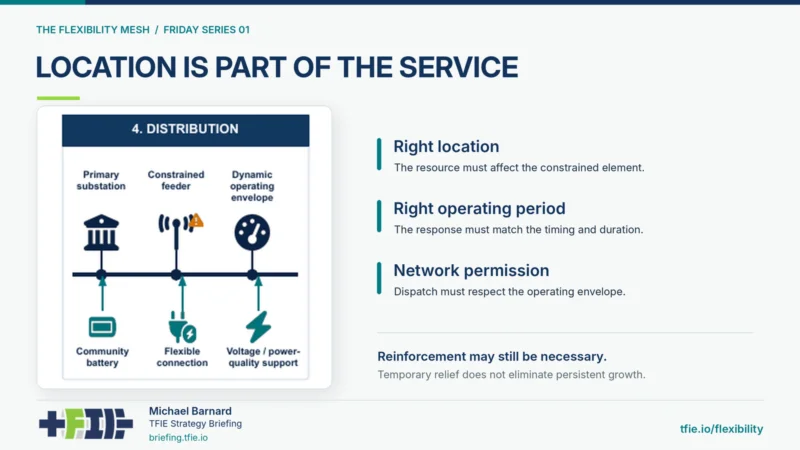
Ireland’s first national assessment of distribution-grid flexibility puts a specific local need behind a broader planning question: can a flexible resource change power flows at the point where the network needs help? At the Naas 38 kV/10 kV substation, the modeled requirement for 2028 is 0.6 MW and 3 MWh, concentrated in January. The figures describe a potential network need, not a commitment to buy a service or install storage.

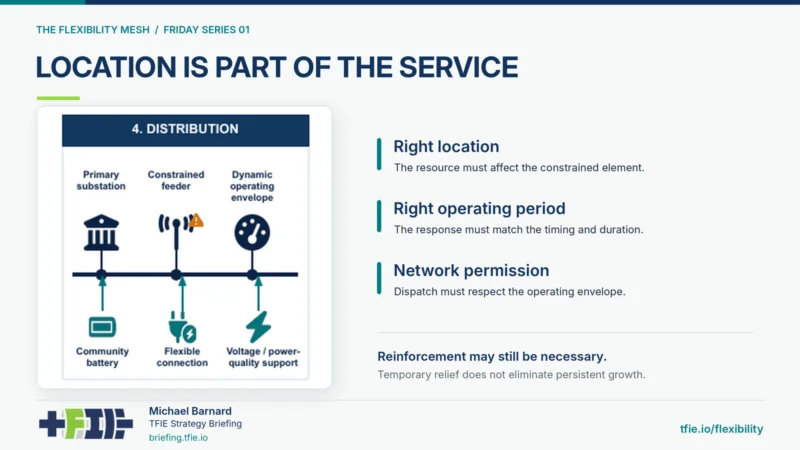
Illustration: Michael Barnard / TFIE Strategy Briefing. The useful capacity depends on where a resource connects and when it can respond.
National capacity does not solve every local constraint
The Commission for Regulation of Utilities’ Flexibility Needs Assessment estimates about 234 MW and 58 GWh of potential upward flexibility requirements across Ireland’s distribution networks in 2028. Those national figures indicate the possible scale of demand for flexible resources, but they don’t show whether any particular battery, vehicle fleet or industrial load can serve a particular substation.
That distinction is the practical point in the Naas example. A battery elsewhere in the country might help balance the wider electricity system, support renewable generation or earn revenue in electricity markets. It still may not ease a constraint at Naas. To do that, its charging or discharging must change flows across the equipment under pressure, in the needed direction and during the relevant hours.
Flexibility is therefore partly a matter of electrical geography. Two resources with similar power ratings can have very different value to a network if one is connected beyond the constrained equipment and the other is not. The question for planners is not simply how much flexible capacity exists in the country; it is where that capacity sits in relation to the constraint.

A flexible resource has to affect the constrained electrical equipment at the right time.
Vehicles and businesses need room to respond
Electric vehicles could contribute through managed charging, but a large national fleet doesn’t automatically translate into usable flexibility at Naas. The vehicles need to be connected at locations that can affect the relevant network equipment, and their charging schedules need to be adjustable when the constraint occurs. Drivers still need enough charge for their planned journeys, so the service has to fit around real use.
Industrial and commercial demand response faces a similar test. Refrigeration, heating and other loads may be adjustable for some periods, but a network service depends on the timing, duration and location of that adjustment. A business’s operating needs also shape what it can offer. The scale of a load by itself says little about whether it can reliably respond to a local network requirement.
Naas’s two figures describe different dimensions of the modeled need: 0.6 MW of power and 3 MWh of energy. Their ratio alone doesn’t establish that the network needs a battery to discharge continuously for five hours. The actual fit depends on when and how long constraints occur, how much time a resource needs to recover between events, and what limits apply to the customers or equipment providing flexibility.
Some constraints call for engineering work
A March 2026 assessment by UK Power Networks offers a useful comparison. The company said it had stopped seeking flexibility tenders for certain single-transformer substations where constraints typically lasted 24 hours. Available flexibility services could not address those requirements effectively on technical and commercial grounds. In cases like these, network reinforcement or another engineering intervention may fit the problem better than asking flexible resources to cover it.
At Naas, reinforcement is planned by 2030, and the assessment identifies no corresponding flexibility requirement for that year. That makes the modeled 2028 need a time-limited planning signal in the assessment. It doesn’t establish which resource would be selected, whether a service will be procured, or how any arrangement would operate.
As distribution networks accommodate more EVs, heat pumps, batteries and distributed generation, national estimates will help describe the broad scale of flexibility needs. Local evidence will determine whether a resource can deliver a useful service: its connection point, response direction, availability during constrained periods, operating duration and ability to meet customer requirements.
The Naas case is the first in a series linked to The Flexibility Mesh, an open 99-page strategy report about how physical resources, permissions, operating capabilities and commercial arrangements fit together. For network planners and providers, the useful takeaway is specific: assess flexibility against the equipment and hours that need support, then compare that need with reinforcement and other engineering options.
A fuller analysis of Naas, potential utility responses and the conditions needed to turn flexible capacity into a deliverable network service is available in the TFIE Strategy Briefing analysis. The next practical question is whether resources connected in the right places can meet the modeled need before the planned reinforcement is complete.