2027 Audi Q9 and SQ9 First Drive: Size, Space and V8 Performance
Audi’s new flagship three-row SUVs pair a roomy cabin with composed handling; the SQ9 adds a 591-hp V8 and a 3.8-second claimed sprint to 60 mph.
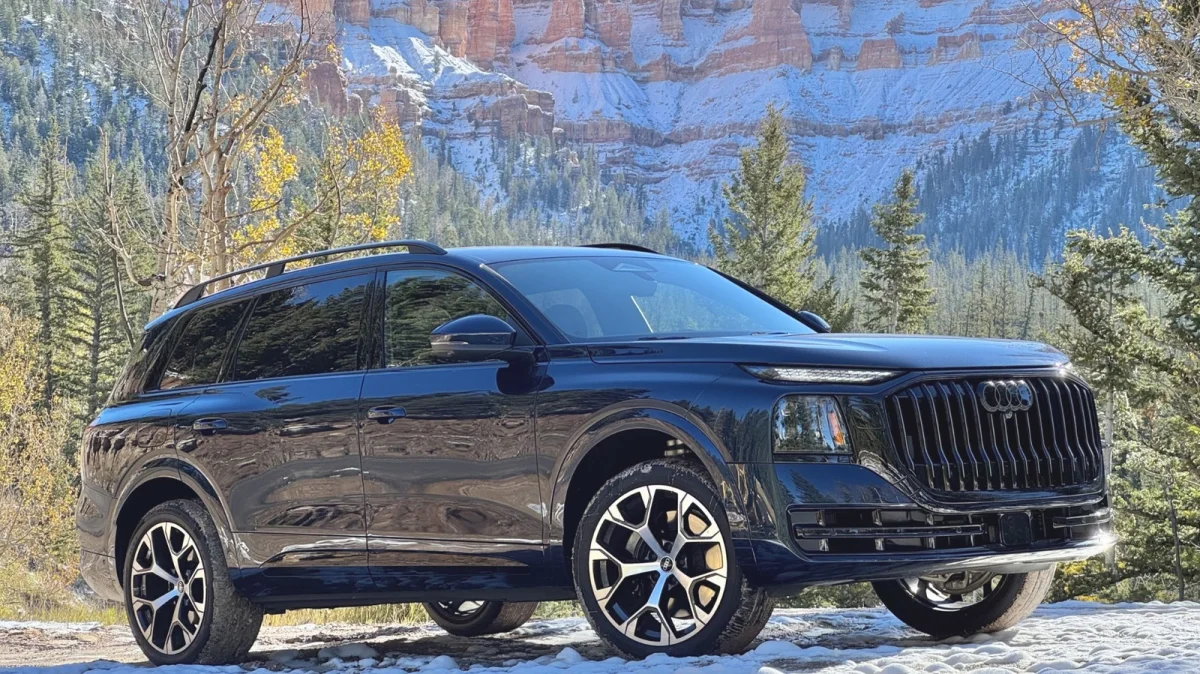
Audi’s new Q9 gives the brand a larger, more spacious three-row flagship, while the SQ9 turns the same family-sized formula into a 591-hp performance SUV. Both feel unusually agile for vehicles of this size, but the driving experience comes with trade-offs: a firm ride, some road noise and a third row that suits smaller passengers better than adults on long trips.
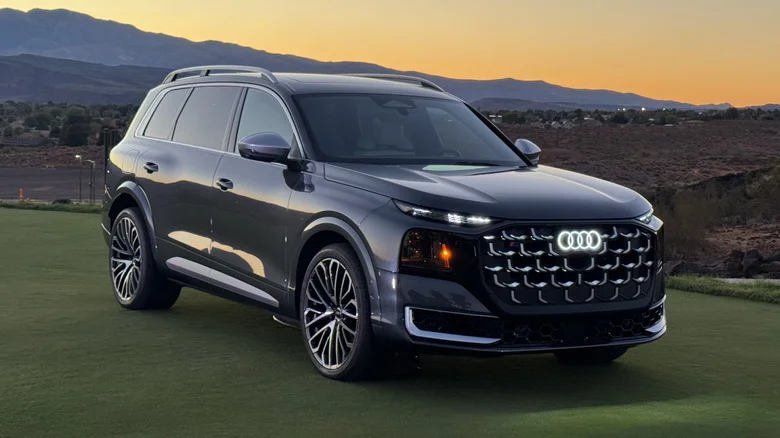
The Q9 arrives for 2027 alongside a larger redesigned Q7. Audi’s older Q7 helped establish the brand’s reputation for a stylish, car-like take on a three-row SUV, but its second generation is now a decade old and sits toward the smaller end of the class. The Q9 moves Audi into a larger size bracket, with room for up to seven occupants and their luggage. It’s aimed squarely at buyers who want a substantial luxury SUV without giving up the brand’s restrained styling and road manners.
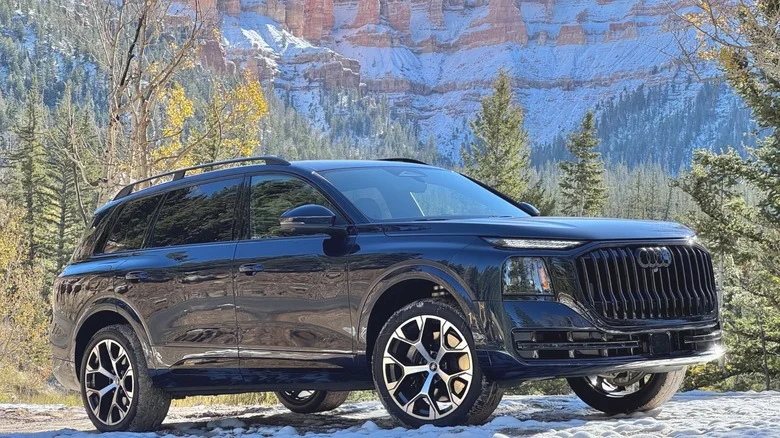
The Q9 and SQ9 were driven during a first-drive event in St. George, Utah. The author’s test vehicles were heavily optioned, and Audi covered travel, lodging and meals for the event. That context matters: the cabin quality and equipment described here reflect high-spec versions, and the experience of a less expensive trim could differ.
A larger footprint, familiar powertrain choices
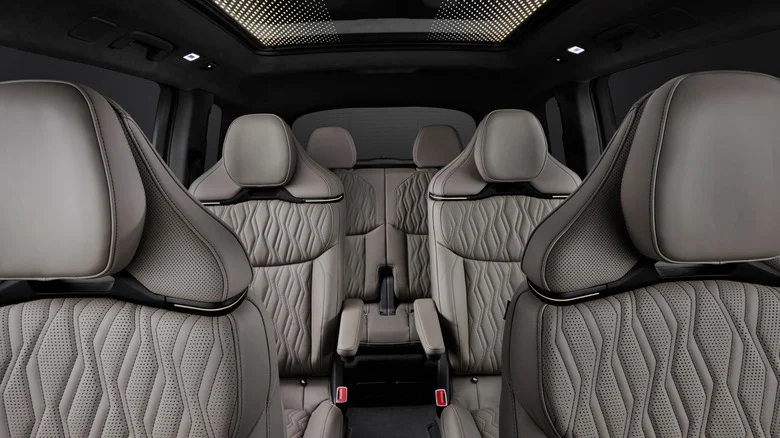
Compared with the 2027 Q7, the Q9 stretches 9.9 inches farther to 209 inches overall. Its 123.5-inch wheelbase is 5.6 inches longer, and its 71.4-inch height adds 0.2 inch. The SQ9’s body is 1.2 inches wider than the standard Q9, though both measure 86.8 inches across with the mirrors included. These dimensions give the Q9 a more substantial presence and, especially in the second row, more room to spread out.
Both models share their basic engine line-up with the new Q7. The Q9 uses a twin-turbocharged 2.9-liter V6 rated at 429 horsepower and 442 lb-ft of torque. An eight-speed automatic sends power to all four wheels through Audi’s Quattro system. The SQ9 swaps in a twin-turbocharged 4.0-liter V8 producing 591 hp and 590 lb-ft, paired with the same transmission.
The SQ9 also gets a different Quattro set-up, with an electronically controlled all-wheel-drive clutch and a rear differential lock. Audi designed the system to allow greater oversteer angles. In the test drive, the author didn’t push the rear differential far enough to assess that claim, but the SQ9’s grip and cornering composure were clear on winding roads.
For towing, the test Q9 had an $850 trailer hitch and a stated capacity of 7,700 pounds. That’s a useful figure for shoppers who need a large family SUV to pull a trailer, though the article provides no fuel economy or real-world towing range figures.
Cabin technology is mostly well judged
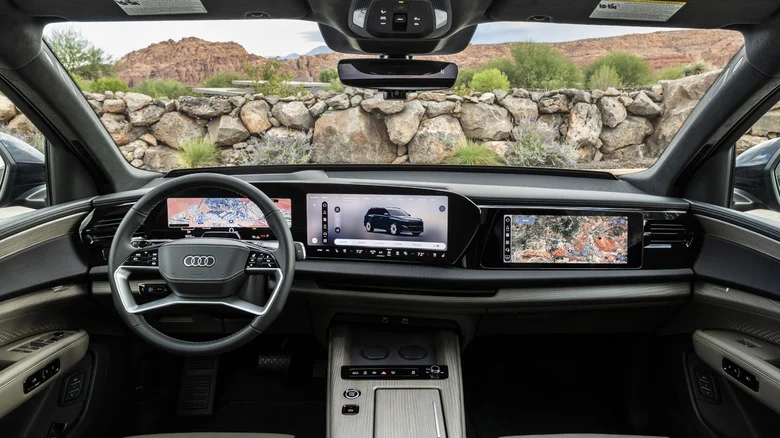
Audi’s latest MMI system puts a 14.5-inch central touchscreen alongside a 12.3-inch screen for the passenger, with digital gauges completing the multi-screen layout. The interface was easy to navigate during the drive, and its menus were arranged in a way that felt straightforward rather than needlessly elaborate. The passenger display, however, seemed less useful in practice: it adds another screen, but the passenger still has to use the driver-facing center display for some seat adjustments.
That arrangement was particularly awkward when adjusting the front passenger seat’s side bolsters and thigh support. Those controls were available only through the center screen, which angles toward the driver and sits a reach away from the passenger. It’s a small usability flaw in a cabin that otherwise makes a good first impression.
The test Q9 also had front sport seats with extensive adjustment and a strong massage function. Its electrochromic panoramic roof could change its tint, and the test vehicle included ambient lighting integrated into the glass. Audi said the ambient-light roof feature would be delayed on production vehicles. The author found it more showy than useful, a reminder that the most conspicuous luxury extras don’t always improve day-to-day comfort.
The optional 4D Bang & Olufsen sound system adds seat-bottom vibrations that follow the bass. That effect felt unnecessary to the reviewer, but the stereo itself sounded excellent. On the highway, music and the massage function also provided a welcome way to soften the impact of road noise from some pavement surfaces.

Big SUV dimensions, surprisingly tidy road manners
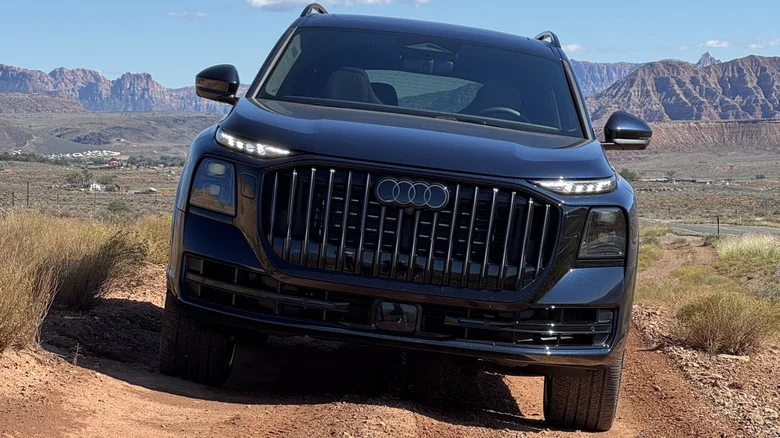
The Q9 felt smaller behind the wheel than its measurements suggest. The test vehicle had Audi’s Prestige package, which includes four-wheel steering. At low speeds, the rear wheels turn by up to five degrees to tighten the turning circle; at higher speeds, the system is intended to improve stability. It made parking-lot manoeuvres feel far less cumbersome, and the reviewer found the Q9 easier to place than the longer, wider Mercedes-AMG GLS63 driven shortly before it. The Mercedes doesn’t offer rear-wheel steering.
On faster, twistier roads, the Q9 carried its weight well. At 5,302 pounds, it’s hardly light, but it felt nimble for its class, with direct, communicative steering and a character closer to a large wagon than a traditional SUV. The twin-turbo V6 delivered smooth, ample power, including on steep roads at an altitude of 10,000 feet.
There was some turbo lag at low engine speeds. Once the engine came on boost, though, it pulled strongly and smoothly. The Q9’s six-piston front brake calipers grip 15.7-inch rotors, and their stopping power was more than enough to make loose objects in the cabin shift forward under hard braking.
The SQ9 makes the standard model feel like the starting point. Its 162-hp and 148-lb-ft advantage over the Q9 didn’t announce itself immediately, but the gap became unmistakable with launch control. To activate it, the driver must select Dynamic mode and press the traction-control button once to enter Sport Traction mode before applying both pedals. The author’s first attempt didn’t use that setting and felt underwhelming; the next one made the system’s potential clear.
Audi says the 5,556-pound SQ9 can reach 60 mph in 3.8 seconds. With launch control engaged, the SUV surged away hard enough to prompt an immediate burst of laughter from the driver. That’s a startling claim for a three-row family vehicle, and the test drive suggests the SQ9’s V8 delivers the kind of acceleration that will feel special even to drivers accustomed to quick cars.
In corners, the SQ9’s standard four-wheel steering and sport-tuned adaptive air suspension helped it stay composed. On tight switchbacks, it resisted understeer and felt remarkably flat for a vehicle nearly 17.5 feet long. The author didn’t test the rear differential’s claimed oversteer behaviour, so that feature remains an open question from this drive. The brakes are upgraded as well: six-piston front calipers work with 16.5-inch discs and a firm pedal with little initial softness.
The reviewer found the SQ9 more capable on winding roads than the facelifted 2027 Mercedes-AMG GLS63 driven in Colorado a few weeks earlier. That’s a subjective comparison from a short drive, but it points to the SQ9’s central appeal: it adds serious pace and cornering ability without abandoning the three-row layout.
Firm suspension, with comfort still in the mix
Audi’s Quattro development specialist Dieter Weidemann said the team didn’t want the Q9 to ride like a “flying carpet.” In practice, the suspension was taut and athletic without feeling harsh or jittery. The test Q9 rode on 22-inch wheels, yet its firm calibration remained comfortable enough, particularly once the pace picked up on more demanding roads.
The SQ9’s sport air suspension offers a broader difference between Comfort and Dynamic modes. In Comfort, it rode at roughly the Q9’s level: controlled and firm without becoming uncomfortable. Dynamic mode brought a noticeably stiffer response than the Q9’s equivalent setting. That made the ride busier over broken pavement, while keeping the body flatter through corners.
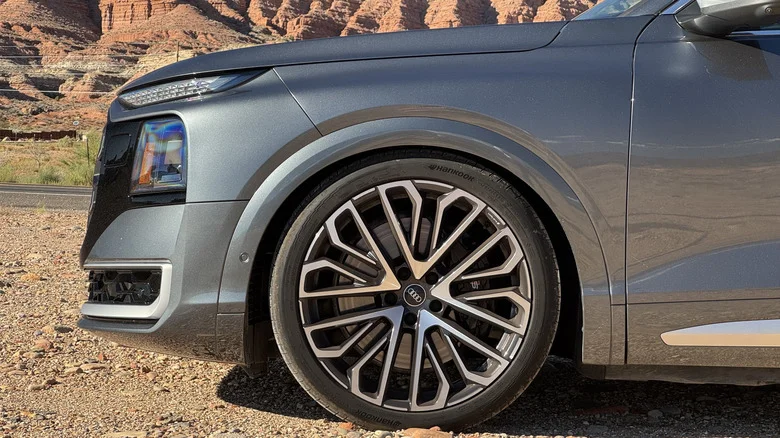
Highway wind noise was well contained, but the cabin let in more tire and road noise than the reviewer expected on some surfaces. The large wheels may have contributed. It’s a practical consideration for buyers who spend long stretches on rougher highways: the Q9’s insulation is good, but not flawless.
Hands-free assistance takes an unusual approach
Premium Plus and Prestige versions offer Audi’s Adaptive Cruise Assist Plus, the brand’s first hands-free driving function. The system is designed for divided highways and works much like other hands-free highway assistance systems. During the drive, two flashing white lights appeared near the bottom of the instrument cluster, along with a message indicating that hands-free assistance was available.
Engagement was simple, perhaps too simple: the driver lets go of the steering wheel, and the lights turn green when the system takes over. The author found it easy to activate unintentionally. While approaching a construction zone, for instance, a change in grip was enough to start the system just as the driver wanted to take control directly.
Once active, it worked well for much of the drive, but recent lane shifts and construction zones confused it. Audi’s system, like the other driver assistance features described in the article, is Level 2; the driver remains responsible for the vehicle. The hands-free operation could be convenient on suitable highway stretches, but the test suggests drivers will need to understand its activation cues and stay ready to steer themselves.
Materials and space depend on the trim
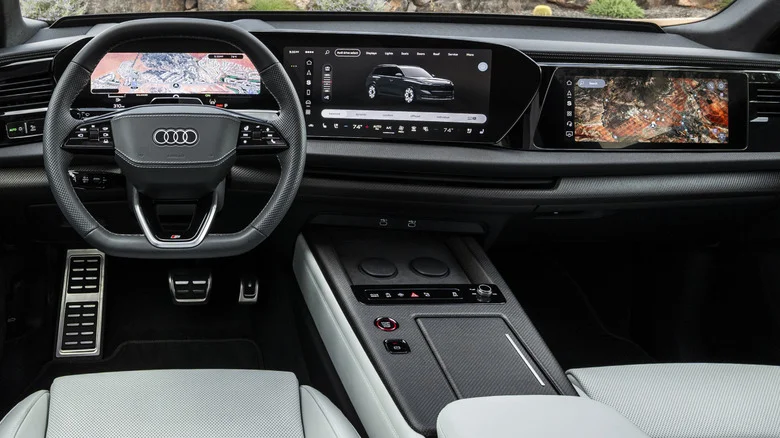
The cabins in both test vehicles recalled the careful finish associated with earlier Audis. Most of the surfaces the reviewer touched felt substantial, and the SQ9’s carbon basalt structure inlay offered a distinctive alternative to familiar carbon-fiber trim. Its matte finish and unusual texture were pleasant to touch and didn’t show fingerprints.
One exception was the padded fabric shelf below the central display, which felt out of place beside the otherwise well-finished cabin. There’s also a qualification to the reviewer’s praise: both test vehicles had the Luxury package, which adds a Dinamica suede-like headliner and extended leather on the dashboard, upper doors, center console and armrests. The finish of less expensive versions wasn’t assessed.
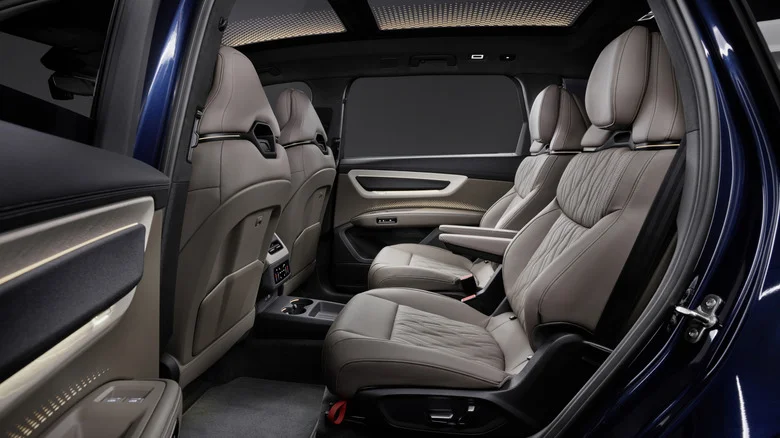
The Q9’s front row offered plenty of room for the 6-foot-8-inch reviewer, though it doesn’t add space over the Q7. The biggest gain is in the second row, which gets 2.3 inches more legroom than the new Q7. Third-row figures need some context: the Q9 is listed with 29.1 inches of legroom, the same as the Q7, while providing 1.5 inches more headroom.
Audi explained that the published third-row legroom measurement is taken with the second row in its rearmost position. Because the Q9’s second-row seats travel two inches farther back than the Q7’s, moving them forward creates more room for the passengers behind. The reviewer found the second row spacious, even behind his own driving position, but described the third row as low to the floor and uncomfortable for a tall adult. Smaller passengers should fare better, though younger knees and shorter journeys seem a more natural fit.
Cargo capacity grows along with the body. With all three rows in use, the Q9 offers 19.3 cubic feet behind the third row, 4.2 cubic feet more than the Q7. Behind the second row, capacity rises by 6.1 cubic feet to as much as 50 cubic feet, depending on seating configuration. Fold both rear rows and the Q9 provides 87.1 cubic feet, 9.1 more than the Q7. The optional second-row captain’s chairs add individual seating but don’t fold flat, limiting maximum cargo capacity.
Prices climb quickly with options
The Q9 Premium starts at $89,095, including destination. Its standard equipment includes digital gauges, a passenger display, adaptive air suspension, a surround-view camera system, adaptive cruise control with lane-departure warning, automatic parking with acoustic sensors, ambient lighting, navigation and a Bang & Olufsen sound system. Four-zone climate control, a head-up display, heated front seats and steering wheel, leather upholstery, a panoramic sunroof, a power tailgate and a power-folding third row are also included, along with customizable exterior light signatures.
Audi includes scheduled maintenance for three years or 30,000 miles at no additional charge, according to the source. The article doesn’t provide fuel economy, expected running costs or reliability data, so those ownership factors remain unknown from this first drive.
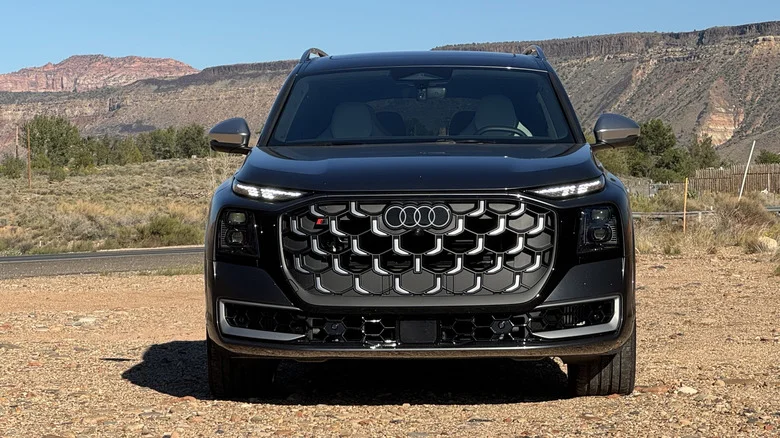
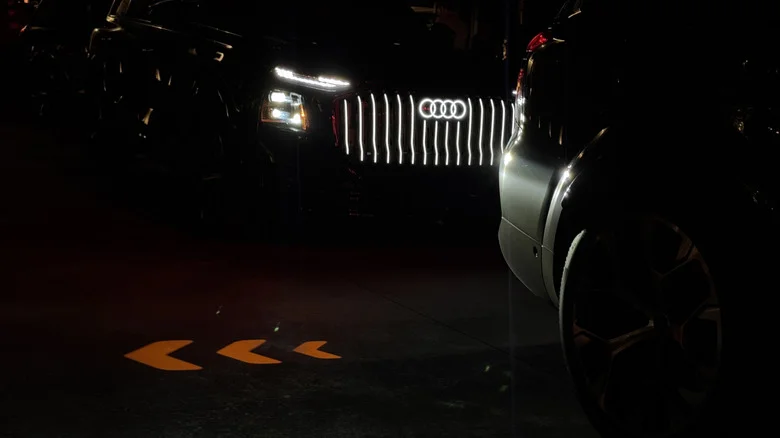
The test Q9 cost $111,895 with its options. That included the $14,700 Prestige package, a $2,800 Black Optic styling package, the $4,000 Luxury package, an $850 trailer hitch and $450 second-row captain’s chairs. The reviewer would personally skip the Black Optic package. The Prestige package adds four-wheel steering, the 4D Bang & Olufsen system, curved digital OLED taillights, massaging Nappa leather sport seats, an electrochromic panoramic roof, an illuminated grille and more extensive ambient lighting.
Digital matrix LED headlights are another notable Q9 feature, available in the United States for the first time. Along with glare-free automatic high beams, the lights can project graphics, including orange arrows on the ground that indicate the direction of a turn.
Powered doors add convenience and a trade-off
The $4,000 Luxury package includes electronically operated doors. They opened reliably during the drive, and ultrasonic sensors helped prevent them from striking nearby people or obstacles. The feature could be useful for parents or anyone carrying bags, but the author sometimes had to stand in the door’s path to reach the handle. Doors can also be opened through the myAudi smartphone app.
These doors have no mechanical interior release. Audi says an integrated capacitor has been durability tested for a 15-year service life and is designed to alert the driver if maintenance is needed. That design makes the doors an unusual convenience feature with a clear practical question attached: buyers should understand how the electronic release works and what Audi says about its service life before choosing the option.
A strong new flagship, with the SQ9 as the driver’s pick
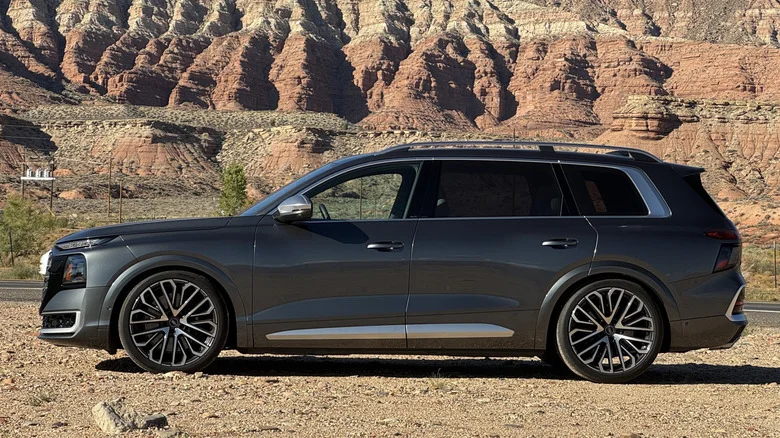
The Q9 looks like a convincing new flagship for Audi. It combines a genuinely spacious second row, useful cargo capacity and confident road manners with a cabin that feels well made in the high-spec versions tested. The standard V6 has enough power for a large family SUV, while four-wheel steering helps the Q9 feel much less cumbersome than its dimensions suggest.
The SQ9 goes further. Its V8 acceleration, strong brakes and composed handling give it a distinct performance character, even though the same firm ride and family-friendly layout remain. The reviewer preferred its driving dynamics to those of the Mercedes-AMG GLS63, while the regular Q9 was already an engaging alternative to a conventional large SUV.
Against the Mercedes-Benz GLS, BMW X7, Land Rover Defender 130 and Lexus TX, the Q9’s appeal is its more restrained, car-like approach. It’s less visually dramatic than the GLS, less unusual than the X7 and less upright than the Defender. Buyers will need to weigh its premium pricing, the Q9’s modest third-row comfort for adults and the cost of packages against its room, finish and handling.
The redesigned BMW X7 is also on the way, so this comparison will change as rivals renew their offerings. For now, the Q9 makes a strong case as Audi’s first entry in this larger three-row class, while the SQ9 is the standout for drivers who want a family hauler with genuinely startling pace.
Volvo XC90 | Land Rover LR3 | Mercedes-AMG GLS63 | Audi Q7 | 2027 Audi Q7 | Audi Q9 and SQ9 overview | Three-row SUVs | Audi digital matrix LED headlights | Lexus TX | Next-generation BMW X7