Tesla Q3 2026: Margins Improve as Robotaxi Miles and FSD Use Rise
Tesla’s margins and cash flow improved as Robotaxi activity expanded, while vehicle demand outpaced battery supply and growth targets shifted.

Tesla’s third quarter brought a stronger financial picture and a sharper focus on scaling its autonomous ride service. Gross margin rose to 19.6% from 16.8% in the previous quarter, while operating margin climbed from 1.4% to 2.6%. Robotaxi mileage also increased quickly. The open question is whether Tesla can turn those gains into a lasting growth engine while battery supply continues to constrain vehicle output.
Margins and cash flow move in the right direction
Revenue was roughly flat at $28.05 billion. Automotive revenue fell about 3% year over year, and Energy Generation & Storage revenue declined about 16% to roughly $2.9 billion, partly due to customer refunds related to tariffs. Services & Other rose to about $4.6 billion. GAAP net income was $787 million, down 43% year over year; non-GAAP net income was about $1.7 billion, or $0.48 per share, above consensus. The results included mark-to-market changes in Bitcoin and SpaceX holdings.
Free cash flow came in at $1.53 billion, against expectations for a multibillion-dollar outflow. Capital spending was $4.73 billion, below the roughly $7 billion to $8 billion some had anticipated. Tesla lowered its full-year capital spending outlook to about $20 billion from more than $25 billion, saying it expects operating cash flow to fund most of that investment. The company also secured about $30 billion in shorter-term debt capacity for possible future spending.
That spending is expected to rise more meaningfully in 2027 and reach “noticeable in the tens of billions” in 2028, according to the call, as Tesla invests in Optimus production lines, AI computing, Cybercab and Terafab. For now, the combination of positive cash flow and a lower spending outlook gives the company more room to pursue those projects without showing the near-term cash burn some had expected.

Vehicle demand meets a battery constraint
Tesla said battery availability, rather than a lack of demand, limited vehicle volumes. The company ended the quarter with its largest passenger-vehicle backlog in four years and reported its highest-ever backlog for energy storage. It also recorded quarterly delivery highs in Canada, Australia, Japan and Taiwan, while Gigafactory Berlin posted its highest production quarter.
Capacity plans show activity across several sites. Annual Model Y capacity in Austin increased from more than 250,000 to more than 375,000. Semi capacity advanced from commissioning to 25,000 annually. Tesla said California Optimus production moved from construction into an early ramp, and that production of its first production-quality robots has begun on high-volume lines in Fremont. The company expects initial Optimus customers to be industrial, with outside customers more likely toward the end of 2027. It estimates roughly a year, perhaps a little longer, to reach an annualized production rate of about one million units, or 20,000 per week, while acknowledging remaining work on reliability, wear and AI.
Energy storage deployments reached 13.7 GWh, up 10% year over year. Tesla shipped its first Megapacks made entirely with its own Nevada LFP cells. The Texas Megafactory has moved from commissioning into production, with planned annual capacity of 50 GWh—above the 40 GWh capacity cited for California and Shanghai. Executives expect Megapack volume and margins to benefit as demand from data centers grows.

Robotaxi is the clearest near-term change
The shareholder presentation showed unsupervised Robotaxi miles rising to about 1.7 million, from roughly 250,000 the previous quarter. Tesla said the total had since reached 3.3 million miles. It also launched a site tracking Robotaxi safety information, adding a public source of operating data for a service that has drawn sustained attention.
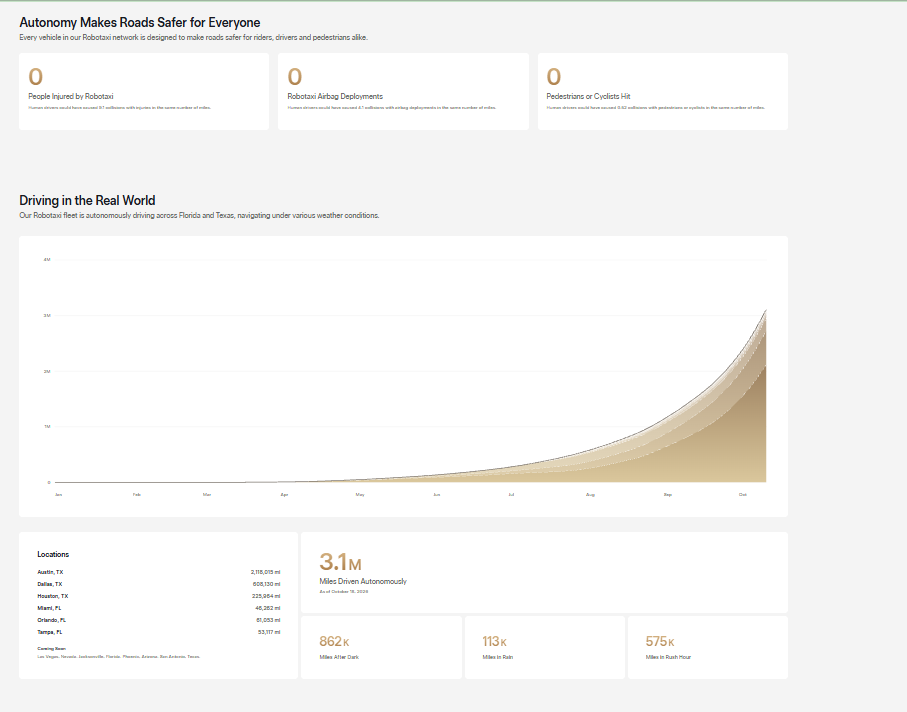
The Austin Cybercab fleet has grown about tenfold since its September 3 launch, and Dallas was mentioned as a possible next city. Tesla expects Robotaxi revenue to become noticeable in 2027 and more significant later that year. The company hopes to sell Cybercabs to other customers by year-end, though the call pointed to 2027 as a more likely timeframe for customer availability. Elon Musk described the vehicle as primarily intended for transport as a service, rather than broad private ownership. Tesla says Cybercab production is scaling quickly and attributes its ease of manufacture to having 50% fewer parts.
Expansion will depend on where the service can operate. Tesla appears comfortable with its software in geofenced areas, a narrower scope than the company’s earlier promise of operation without geographic limits. That may frustrate owners waiting for unsupervised Full Self-Driving (FSD) in their own cars, but it still gives Tesla a path to add service in more cities. The company hopes to offer unsupervised FSD to customer-owned vehicles around Q2 2027, a target that has shifted several times.
FSD adoption, mapping and production targets
FSD’s attach rate on new North American vehicles reached 75%, and active subscriptions rose to 1.74 million from 1.48 million in the prior quarter. Musk called FSD the biggest current driver of vehicle demand. Asked whether competition could force its price lower, Tesla executives argued that building a demonstration that works most of the time is easier than handling the full range of unusual situations encountered on the road.
Tesla also described an AI-driven overhaul of navigation and mapping due in the coming months. The system is expected to learn from individual driver preferences as well as patterns across the fleet. In Europe, the company said four additional country approvals had arrived since Q2, bringing FSD availability to nine countries, with more than 100,000 customers and over 160 million kilometers logged. It hopes for broader approval in the coming months or by Q1, while acknowledging the timing is not entirely in its control.
A new target calls for production capacity of five million vehicles a year by 2030. That is a later timetable than the prior goal of reaching a five-million annual rate by the end of 2028. Tesla also reported that Cortex training compute had risen from more than 205 MW to more than 225 MW, with a previously stated plan to reach 400 MW by year-end. Battery-cell manufacturing capacity showed no change, and Austin Terafab construction continues, with equipment commissioning planned for 2027.
The quarter’s strongest story is the visible increase in Robotaxi activity, alongside improved margins and cash generation. Vehicle growth remains harder to judge: Tesla continues to describe demand as strong, but battery availability is limiting deliveries and the five-million-unit target has moved further out. How quickly new capacity arrives—and whether Robotaxi mileage can become dependable revenue—will shape what these results mean for buyers and the business.