Electric Hydrofoil Pilot Boats Face a Tough Cost Test in Antwerp
An Antwerp operating model puts the EF-12 hydrofoil’s 15-year cost about 40% above a diesel tender, despite lower energy use.
Electric hydrofoils can cut water resistance and energy use, but a harbour workboat only benefits when it can spend enough time foiling. An exploratory cost model for Antwerp puts that operating constraint at the center of the business case: the Artemis EF-12’s modeled 15-year discounted cost is about 40% higher than a conventional diesel tender’s.
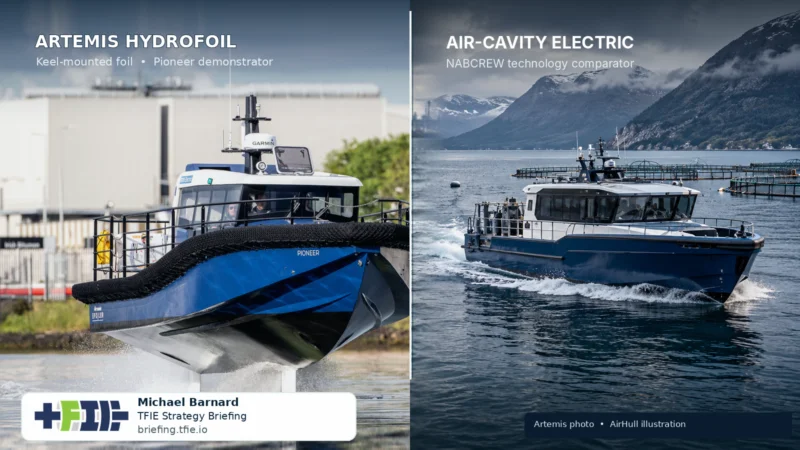
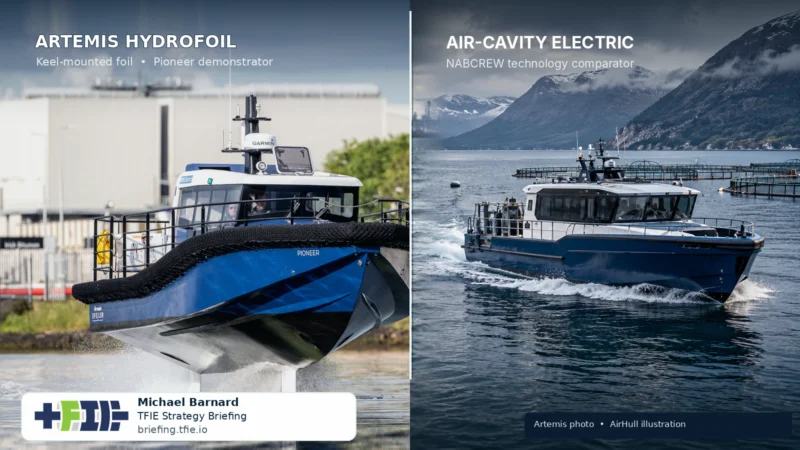
The comparison concerns Brabo, the Antwerp pilotage operator, which ordered an Artemis EF-12 electric hydrofoil pilot boat in August 2024. The vessel pairs electric propulsion with submerged foils and active controls. Artemis has demonstrated ship-contact manoeuvres with its EF-12 workboat platform, and the EF-12 Pilot design entered sea trials in 2026. For pilot transfers, the vessel’s handling may matter even when it is travelling too slowly to rise onto its foils.
Harbour work limits time on the foils
Antwerp pilot boats work around docks, locks and moving ships, with assignments that can change throughout the day. These conditions make top speed an incomplete measure of value. A hydrofoil’s efficiency advantage depends on suitable water and enough time at speeds where the hull lifts clear. Manoeuvring and travel through constrained waterways can leave little opportunity to use that mode.
A Python-based operating model tested three hypothetical sets of port-speed permissions using synthetic assignments. In the scenarios, the EF-12 spent zero, approximately 6% or approximately 13% of its underway time foilborne, depending on the amount of suitable high-speed water. Those percentages are modeled outcomes. They are not measurements of Brabo’s service, and they do not describe actual Antwerp speed authorizations.

That distinction matters when interpreting the cost comparison. The model estimates a discounted 15-year cost of approximately €5.32 million for the EF-12 in its central case, against €3.81 million for a new conventional diesel tender. The roughly 40% premium reflects a comparison between two newly purchased vessels; it doesn’t measure the cost of retaining an existing diesel boat.
Lower energy use doesn’t settle the economics
Electric propulsion brings a substantial energy advantage in the comparison, but savings from purchased energy aren’t enough to offset the assumed capital cost when the boat rarely operates in its most efficient regime. The hydrofoil’s active controls and potential ride-quality benefits could matter to the service. The analysis, however, did not assign those benefits a financial value, so the cost result should be read as a modeled comparison rather than a complete valuation of every operational benefit.
For fleet operators, the practical question is how often a vessel can use its defining feature while still completing its assigned work. If schedules mostly involve short, slow movements, the hydrofoil’s energy advantage has fewer chances to accrue. If routes provide longer high-speed runs, the balance could shift. The model’s range of outcomes points to operating patterns as a key input alongside vessel price and energy consumption.

That’s why the result shouldn’t be treated as a universal verdict on hydrofoils. Different routes, operating constraints and purchase prices could produce different economics. A useful comparison needs to reflect actual assignments and the total cost of delivering the service, not just the boat’s peak capability.
An air-cavity design offers another route
A second electric approach in the comparison is an air-cavity electric personnel vessel developed by Norway’s Moen Marin and Pascal Technologies. Rather than lifting most of the vessel clear of the water, the design reduces hull resistance with an air cavity. It performed better financially than the hydrofoil in the exploratory model.
There’s a practical caveat: the existing craft was designed for aquaculture work. It would need suitable adaptation and certification before it could serve as a pilot tender. Its modeled result therefore shows a possible direction for comparison, not evidence that the craft is ready to replace a pilot boat.
The same operating logic applies to the proposed Vancouver hydrofoil ferry. Hydrofoils look strongest on routes with sustained faster passages and conditions that allow the foils to do their job. In a busy harbour, manoeuvring demands and limited time at speed can make added cost and complexity harder to justify.
For Brabo and other operators assessing electric workboats, the most useful next step is to match vessel costs and energy use to real dispatch patterns. How much time can the boat actually spend foiling? How often will harbour work keep it at low speed? Those answers will show whether reduced resistance can earn back the hydrofoil’s premium.