Toyota’s New 1.5-Litre Hybrid Targets More Than 15% Better Fuel Economy
Toyota’s new four-cylinder hybrid system targets over 15% better fuel economy and could support hybrid, plug-in hybrid and electric models.
Toyota’s developing a smaller hybrid system around a new 1.5-litre four-cylinder petrol engine, with a fuel economy target more than 15 percent above its current strong-hybrid configurations. The figures and applications remain unconfirmed, but the engineering direction is clear: Toyota wants a powertrain designed as a complete hybrid package, rather than an existing engine adapted to work with electric components.
That distinction matters because efficiency depends on how the engine, electric motors and power electronics work together. Toyota says it has developed those elements as a coordinated system to reduce losses. The company is preparing both naturally aspirated and turbocharged versions, which could let the basic engine serve different vehicle types and performance needs.
A hybrid system built around the engine
The naturally aspirated version is expected to deliver performance similar to Toyota’s existing 1.8-litre engine and 1.5-litre three-cylinder unit. That comparison gives a broad indication of the intended output, but Toyota has not provided power, torque, consumption figures or details of the vehicles that might use it.
The fuel economy target is a development goal, not a confirmed result for a production model. Real-world consumption will depend on the vehicle, its weight, gearing, driving conditions and the way the electric side of the system is calibrated. Toyota hasn’t said how much of the targeted improvement comes from the new engine itself, the redesigned hybrid architecture or their combined operation.
Offering naturally aspirated and turbocharged versions adds flexibility, though the company hasn’t described their intended roles. A naturally aspirated setup could suit applications where the priority is efficient, predictable power delivery. A turbocharged version could provide another way to match engine output to a vehicle’s needs. Those are possible uses of the two formats; Toyota has not named specific models or confirmed their specifications.
Packaging could shape future vehicle designs
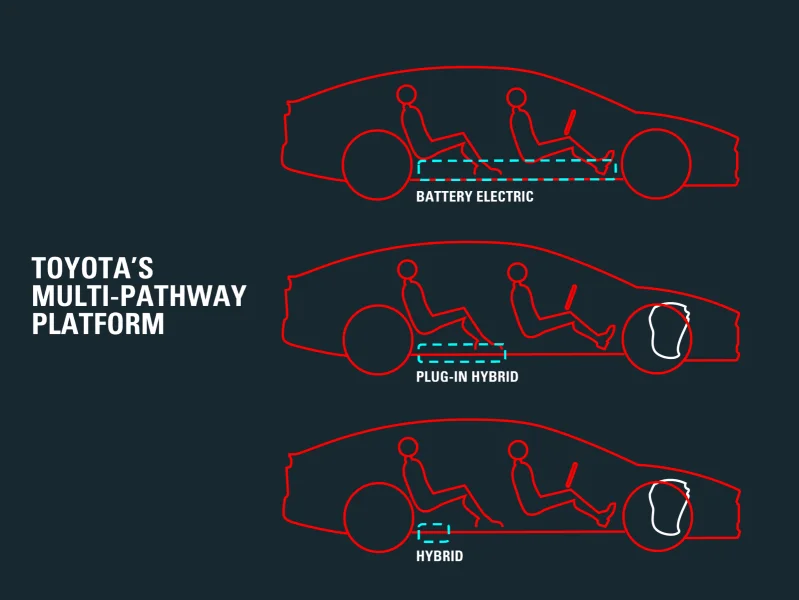
Toyota is also working to make the complete hybrid system smaller. A more compact arrangement can give vehicle designers additional room to position components and shape the body. The company says it could allow a lower bonnet and make space available for other parts of the vehicle.
There may be an aerodynamic benefit, too. A lower front end can give designers more freedom to manage airflow, although Toyota hasn’t quantified any reduction in drag. Nor has it said how the revised packaging will affect cabin space, cargo capacity or servicing access. Those details will matter to buyers alongside fuel consumption: a compact powertrain only improves the ownership proposition if it fits into vehicles without compromising everyday practicality.
The engine is intended for Toyota’s future multi-pathway vehicles, which are planned to support hybrid, plug-in hybrid and battery-electric powertrains. The shared vehicle architecture could let Toyota use a common foundation across models with different propulsion systems. The company says that approach could help share development and manufacturing costs, while giving factories more flexibility to adjust output according to demand in different markets.
That flexibility is a manufacturing aim, not a confirmed production plan for any particular plant or model. Toyota hasn’t said which vehicles will use the new architecture, when it will enter production or how many versions will be built. The listed powertrain support and engine formats describe the programme’s intended scope:
| Item | Planned support |
|---|---|
| Powertrain types | Hybrid, plug-in hybrid and battery electric |
| Engine | 1.5-litre four-cylinder |
| Engine formats | Naturally aspirated and turbocharged |
What it could mean for India
Toyota hasn’t confirmed an Indian model, local production or a launch date for the new system. Its development is still relevant to the market because Toyota already sells strong-hybrid vehicles in India. The Urban Cruiser Hyryder and the Maruti Suzuki Grand Vitara currently use a 1.5-litre three-cylinder hybrid setup.
A new four-cylinder system could give Toyota another option for future vehicles, but the engine’s displacement alone doesn’t tell buyers how it would compare with the existing setup. There are no confirmed Indian specifications, prices, consumption figures or details about which models could receive it. Those answers will determine whether the new hardware brings a meaningful difference in running costs, refinement or vehicle choice.
Toyota is also considering whether to offer the engine and hybrid technology to other manufacturers. It is studying compatibility with renewable and carbon-neutral fuels as part of development. Neither point comes with confirmed partners, named fuel types or a timetable, so the practical scope remains unclear.
For drivers, the main figure to watch is Toyota’s target of more than 15 percent better fuel economy against its current strong-hybrid configurations. Whether that becomes a real advantage will depend on production specifications and how the system performs in the vehicles it powers. Power, torque, consumption, availability and India applications are still to come.
The post Toyota’s New 1.5-Litre Hybrid Engine Could Bring More Mileage! first appeared on Motoroids.
===