Europe’s Battery Plans Depend on Stable Demand, T&E Says
T&E says EU cell output could cover supported EV demand by 2030, but battery projects need firm targets across cells, cathodes and precursor materials.

Europe’s battery industry has lost projects, but its remaining production pipeline could cover demand from vehicles supported under the proposed Industrial Accelerator Act (IAA), according to an analysis by Transport & Environment (T&E). The group’s central argument is that firm local-content requirements would help turn planned factories into operating capacity, particularly for cathode and precursor materials.
The findings also challenge a claim by Mobility Global, in a study commissioned by ACEA, that Europe faces a 150 GWh battery gap in 2028. T&E argues that the estimate rests on restrictive assumptions about which cells count as available and how much vehicle demand would fall under the IAA. The difference matters: a projected shortfall can reflect manufacturers’ sourcing choices without demonstrating that physical production capacity is missing.
Cell capacity is damaged, but still substantial
About a quarter of the EU battery cell capacity announced since 2022 has been cancelled or put on hold, T&E finds. Germany has been particularly affected: its project pipeline for 2035 has halved. Companies based outside Europe, predominantly South Korean manufacturers, account for more than 72% of active cell manufacturing capacity on the continent.
Even so, Europe is not starting from scratch. More than half of the cells in electric vehicles sold in the EU today are already made in the region. European production is developing around both nickel-manganese-cobalt (NMC) and lithium-iron-phosphate (LFP) chemistries. LFP remains an area where Europe has more ground to make up, but T&E says the region is on track to produce more than 100 GWh of LFP cells by 2030. That figure could reach 140 GWh if all potential projects proceed.
Using expected output rather than factories’ nameplate capacity, T&E estimates that EU cell production could meet demand from corporate electric vehicles by 2027. A substantial share of demand from supported private vehicles could also be covered by local output. By 2030, the analysis says, existing cell production could supply both groups.

Cathodes and precursors need clearer demand
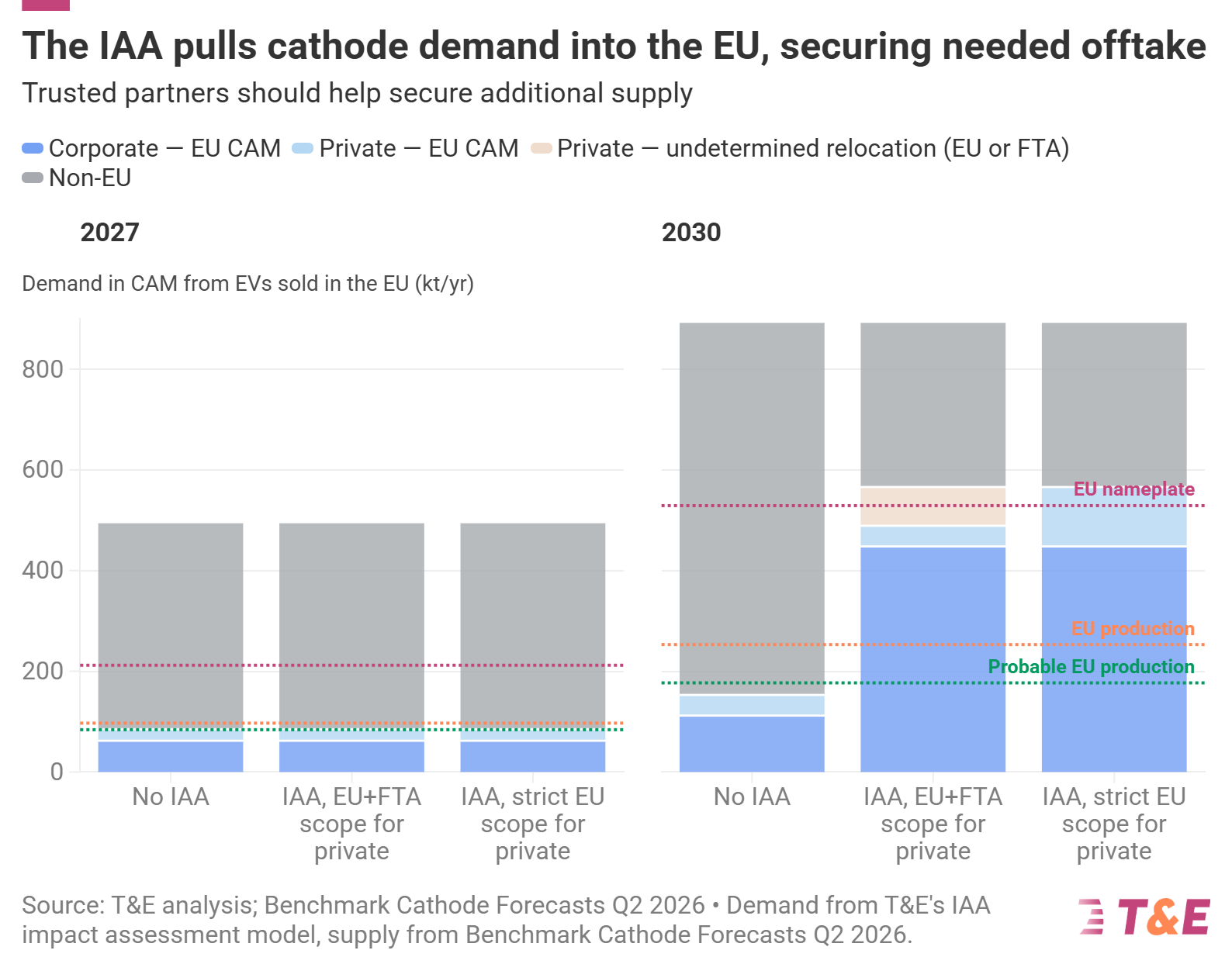
Cell factories are only one part of the supply chain. T&E warns that China could retain more than 80% of global cathode active material (CAM) production in 2035, while Europe would account for just 3% without further action. Several European production clusters for NMC and LFP cathodes are emerging, however, and the group says announced capacity could meet demand for cathodes used in corporate vehicles by 2030.
Supplying supported private vehicles would require a broader sourcing scope, T&E argues, including trusted suppliers in Canada and South Korea. The group warns that postponing CAM requirements could prevent local projects from reaching the scale needed to operate. Its concern extends further upstream to precursor CAM (pCAM), a material used in cathode production that can also provide customers for European refiners and recyclers. Of 552.6 GWh of pCAM capacity announced for 2030, just 217.9 GWh remains on track, according to the analysis; the IAA currently has no minimum pCAM threshold.
How T&E disputes the 150 GWh estimate
T&E says the claimed 2028 shortfall is not a straightforward measure of how many cells European factories can physically produce. The Mobility Global study deducts cells exported in cars assembled in the EU and excludes cells that do not fit current local assembly arrangements. T&E says those choices undercount available EU manufacturing capacity, while the study also overestimates demand from vehicles covered by the IAA.
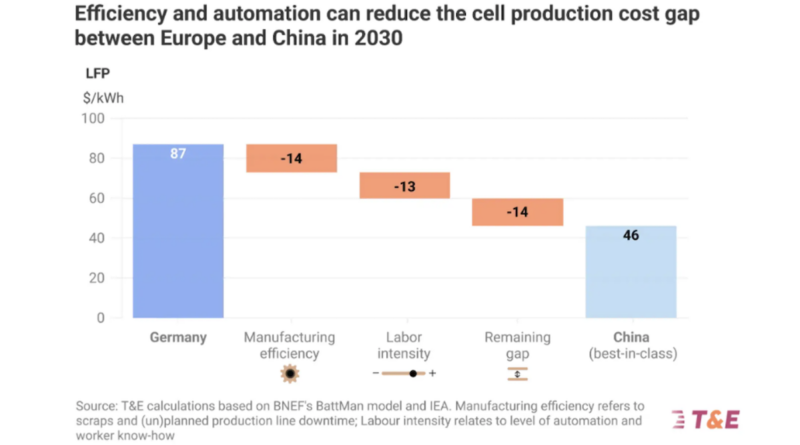
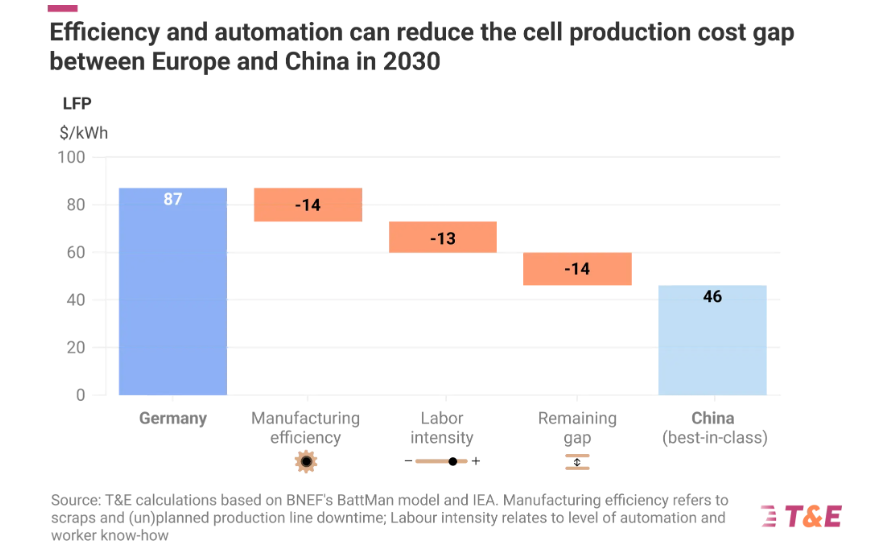
The group disputes the projected cost burden of sourcing European-made batteries, too. It says the cost gap with Chinese cells will narrow as European output grows, estimating that the difference will fall by 70% by 2030. On that basis, T&E puts the added cost at €500 for an average electric vehicle.
The case for stable demand is tied to the difficult transition from pilot production to mass manufacturing. Battery makers and component suppliers must refine industrial processes during this period, when scrap rates can be high. T&E argues that local purchasing requirements could give these projects the demand needed to expand and reduce reliance on Chinese supply.
T&E’s proposed IAA thresholds
The group recommends keeping the proposed 2027–28 cell requirement for corporate cars in Article 13 in its current form. It says this would cover the vast majority of the market, which it estimates at 60% of electric vehicle sales. As another option, it proposes allowing a trusted-partner approach for private and corporate cars, subject to strict entry criteria.
For CAM, T&E wants the 2030 requirements retained and trusted partners included. For 2032, it proposes minimum thresholds of 20% for pCAM and 10% for anode active material (AAM), with trusted partners eligible to contribute. Its recommendations also call for a minimum 20% threshold for lithium, nickel, cobalt and graphite.
Those partner rules, T&E says, should limit circumvention. One suggested condition would exclude projects in countries whose operators hold more than 40% of global manufacturing capacity. The group also proposes requiring small battery-electric vehicles (BEVs) to use EU-made batteries from 2029 or 2030, arguing that expected LFP output could cover the segment.
Finally, T&E opposes carmakers’ proposed “fleet booster” that would allow compliance when 70% of a manufacturer’s fleet meets the requirements. It says that flexibility would weaken demand for cells and CAM and could leave projects without the certainty needed to reach final investment decisions. The key test for the IAA, in T&E’s view, is whether its targets hold long enough for announced capacity to become production.
Source: Transport & Environment. By Franziska Grüning, Raw Materials Officer, Brussels.
Read the briefing and T&E’s response to the ACEA study.